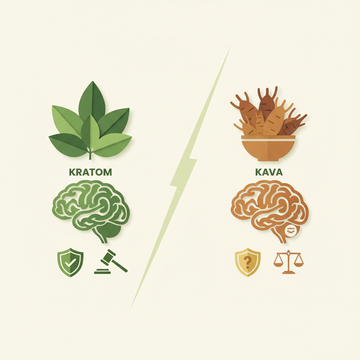

Canadian buyers shopping for botanical products in 2026 increasingly compare them on substance — lab testing, sourcing transparency, regulatory status, packaging — rather than on marketing claims. This article looks at how kratom compares to other commonly-discussed botanicals on those substantive axes, from a Canadian buyer's perspective. It is not health guidance and we don't claim that any of these botanicals does anything for the buyer. It is a comparison framework for Canadian shoppers in 2026.
The five comparison axes that actually matter
When Canadian buyers compare kratom against other botanicals — yerba mate, kava, valerian, passionflower, ashwagandha, others — five practical axes emerge from forum discussions:
- Regulatory status in Canada. Is the product approved by Health Canada? Does it have an NPN number?
- Lab testing transparency. Are COAs available? Per-batch or generic?
- Sourcing transparency. Where does the plant material come from? Are origin claims verifiable?
- Packaging and dosing standardization. Is the product sold in a consistent, measurable form?
- Pricing per gram or per dose. Apples-to-apples cost comparison.
This is a different framework than buyers might have used in 2022, when marketing language dominated comparison conversations. The 2026 framework is more measurable and more skeptical.
Regulatory status — the foundational difference
This is where kratom sits very differently from most other commonly-compared botanicals in Canada. Many traditional herbs (valerian, passionflower, chamomile, ashwagandha) have NPN listings under Health Canada's Natural Health Products framework. Kratom does not have NPN approval; it is sold as a botanical product without health or use claims, and Canadian buyers should be aware that this distinction matters.
For a Canadian buyer, the practical implication is: a botanical with an NPN has gone through specific regulatory review; a botanical without NPN hasn't. This isn't a quality judgment — it's a regulatory fact. Buyers should consult Health Canada listings directly for the current status of any specific product.
Lab testing transparency comparison
Among major Canadian botanical categories, kratom vendors who publish per-batch COAs are a smaller share of the market than vendors of NPN-listed products who provide standard quality documentation. But the gap is closing. Canadian buyers in 2026 expect lab transparency from kratom vendors at a level approaching what NPN products provide as standard.
For our part: we publish a COA for every batch, accessible on the Lab Reports page, linked to the batch number on the bag. This is the standard we hold ourselves to in the Canadian market.
Sourcing comparison
Sourcing transparency varies wildly across botanical categories:
- Chamomile: typically sourced from Eastern Europe (Hungary, Poland) and well-documented across vendors.
- Ashwagandha: Indian sourcing standard, with some vendors specifying farm regions (Madhya Pradesh, Rajasthan).
- Yerba mate: Argentine, Paraguayan, or Brazilian; large vendors specify region.
- Valerian: European sourcing standard.
- Kratom: primarily Indonesian (West Kalimantan, Sumatra); vendor transparency varies a lot. Vendors who name specific regions and farms are a minority but growing.
The Canadian buyer takeaway: kratom sourcing transparency is catching up to where the NPN herbal categories already sit. Vendors who don't name a region in 2026 are increasingly seen as out of step with where the market is heading.
Packaging and dosing standardization
Kratom is sold predominantly as raw powder in bag sizes ranging from 25g to 1kg or more. Other botanicals are more often sold in capsule, tablet, tincture, or pre-measured tea-bag forms.
For Canadian buyers, this means kratom requires more handling than most NPN herbal products — you need a precision scale, a brewing setup, and storage. NPN products often come pre-measured and standardized. This isn't better or worse; it's a different product format.
Pricing comparison
Per-gram pricing varies enormously across botanical categories. Chamomile is among the cheapest (a few cents per gram for bulk tea-grade product). Ashwagandha sits in a mid-tier (root powder cheaper than standardized extracts). Kava and kratom are typically higher per gram than common European herbs. Yerba mate is moderate.
The price differences reflect import logistics, processing complexity, growing conditions, and supply-chain length — not necessarily quality differences.
What this comparison does NOT tell you
This comparison does not tell Canadian buyers:
- Which botanical is "better" for any specific purpose (we don't make such claims).
- Whether any of these botanicals is safe for any specific individual (consult a healthcare professional in Canada).
- Whether one botanical can substitute for another (they have different chemistry and different regulatory status).
It tells buyers how the products differ on measurable, substantive axes — lab testing, sourcing, regulation, packaging, pricing.
The honest buyer-side takeaway
Canadian buyers in 2026 who shop botanicals seriously have developed a measurable comparison framework that works across categories. Kratom sits in a specific position within that framework: distinct regulatory status, varying vendor transparency, predominantly raw-powder format, mid-to-higher per-gram pricing. None of this implies anything about what kratom does for the buyer. It implies how a sophisticated Canadian shopper should think about the product as a market commodity.
For Canadian regulatory context around kratom and the other botanicals mentioned, buyers should always consult Health Canada resources directly. This article is comparison reference content, not advice.