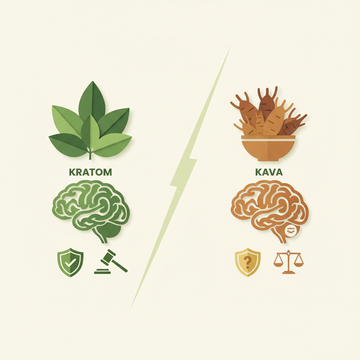

Look at the related-searches that come up on Canadian Google for "kratom" in 2026 and you'll see a consistent set of other botanical products appearing alongside it. Yerba mate, kava, valerian, passionflower, chamomile, ashwagandha, blue lotus — these aren't kratom alternatives in any health sense, and we make no claim that any of them does anything for the buyer. They're simply botanicals that Canadians commonly browse in the same shopping sessions. This article is a reference list — a botanical Who's Who for buyers who want to understand what they're seeing in their Google results.
1. Yerba mate
A traditional South American beverage made from the leaves of Ilex paraguariensis, a holly-family plant native to Paraguay, Argentina, and southern Brazil. Drunk as a tea-style infusion, usually from a gourd through a metal straw called a bombilla. Caffeine-containing. Widely available in Canadian specialty grocery stores and online. Often discussed alongside kratom because both are leaf-based brewed beverages with distinct cultural origins.
2. Kava (kava-kava)
Made from the root of Piper methysticum, a plant native to the South Pacific. Traditionally prepared by grinding or chewing the root and steeping it in water. Has a distinct earthy, slightly numbing taste. Sold in Canada as a dietary supplement (powder, capsules, prepared drinks). The active compounds are kavalactones. Health Canada has issued advisories about kava in the past; buyers should consult current regulatory status.
3. Valerian root
The root of Valeriana officinalis, a flowering plant native to Europe and parts of Asia. Sold as tea, tincture, capsules. Has a distinct, polarizing smell often compared to old socks (genuinely). Widely available in Canadian natural-product stores. Approved as a Natural Health Product in Canada under specific NPN listings.
4. Passionflower
The aerial parts of Passiflora incarnata, a flowering vine native to the southeastern United States. Sold in Canada as tea, tincture, capsules. Has a mild grassy flavour. Listed as a Natural Health Product under specific NPNs in Canada.
5. Chamomile
The dried flowers of Matricaria chamomilla (German chamomile) or Chamaemelum nobile (Roman chamomile). One of the most widely consumed herbal teas in the world. Available in every Canadian grocery store. Mild, apple-like flavour. A botanical staple, no exotic sourcing required.
6. Ashwagandha
The root of Withania somnifera, a shrub native to India and parts of Africa. A central ingredient in Ayurvedic traditions. Sold in Canada as powder, capsules, and root extract. Has a strong earthy, slightly bitter taste. Available under NPN listings in Canada.
7. Blue lotus
The flower of Nymphaea caerulea, a water lily native to Egypt and parts of North Africa. Sold as dried flowers, tea, tincture. Has a faint floral aroma. Regulatory status varies by jurisdiction — Canadian buyers should check current Health Canada listings before ordering.
Why these botanicals appear in the same searches
The overlap in Canadian Google searches between kratom and these seven botanicals isn't accidental. Canadian buyers exploring botanical products tend to browse adjacent categories. Common patterns:
- Buyers researching traditional plant-based beverages from non-Western traditions.
- Buyers interested in botanical product transparency (lab testing, sourcing).
- Buyers comparing flavour profiles for herbal tea routines.
- Buyers building a botanical library for their kitchen.
None of this implies that any of these botanicals are interchangeable, substitutable for kratom, or beneficial for any specific purpose. We make no such claim and we don't sell any of the other six. We mention them here only because Canadian buyers commonly ask us about them in the same email — "I'm also looking at X, do you carry it?" — and the honest answer is to point buyers toward the appropriate specialty vendors.
How regulation differs across these botanicals
An important Canadian-context note: regulatory status varies significantly across these botanicals. Some are approved as Natural Health Products (NHPs) with NPN listings (valerian, passionflower, chamomile, ashwagandha). Others have advisory or unclear status (kava). Some, like kratom, do not have Health Canada approval for human consumption. Yerba mate is sold as a food product.
Canadian buyers exploring botanical products should always check the specific regulatory status for each product before purchasing. The general rule: an NPN-listed product has gone through Canadian regulatory review; products without NPN haven't.
What we ship and what we don't
We ship one product line: lab-tested kratom powder in five signature blends. We do not sell yerba mate, kava, valerian, passionflower, chamomile, ashwagandha, or blue lotus. We don't make blends that combine kratom with any of these botanicals.
For Canadian buyers interested in the other botanicals listed here, we recommend looking at specialty herbal vendors who specialize in NHP-listed products, traditional tea shops, or Canadian importers focused on those specific plants. Our product scope is narrow on purpose — one product line, fully lab-tested, shipped from a Canadian warehouse.
Reference, not advice
This article is a botanical reference for Canadian buyers who see these terms in their Google results alongside kratom. It is not a recommendation for any of them, it doesn't claim any of them does anything specific, and it doesn't recommend kratom for any specific purpose either. For all of these botanicals — kratom included — buyers should consult Health Canada resources for current regulatory context.